

Strategic 1-to-1 Meetings in Exclusive Business Referral Networking Groups: A Tactical Framework for Referral Acceleration
In category-exclusive business referral networking groups (such as ProREAL and similar organizations), your seat represents the sole representative of your profession. This structural exclusivity creates both privilege and pressure: you do not compete with other group members for referrals, but you also rely entirely on a finite roster of non-competing peers to act as your external sales force.
When it comes to 1-to-1 meetings in a business referral networking environment, casual catch-ups can be a missed opportunity, as well as the hard one-way sales pitch. Neither of those approaches provides the optimal use of 1-to-1 meetings. While members of the same networking group can sell to each other, that’s not what referral networking is really about. Business referral networking is more about leveraging the network to get leads, beyond whatever the group size itself happens to be. If all you do is sell to members of the group, your leads are finite or limited to the number of people in the group. If you leverage the network to get referrals, then the leads become limitless.
Veteran business networking professionals can actually tell how transient a new member of a group might be if the new member only does hard sales pitches during 1-to-1 meetings. That makes the long-term members of the group less likely to refer to the new member. Simply holding a seat in an exclusive business referral networking group does not guarantee that other members will send you business. Group membership provides the opportunity—it is up to you to take advantage of that opportunity by building professional relationships and referral partnerships.
One of the primary goals of a 1-to-1 meeting is to answer a fundamental diagnostic question: “Do I know this person and their business well enough—and do they know me and my business well enough—for us to confidently and repeatedly refer leads to each other?”
The Referral Continuum: People will do business with those whom they “Know, Like, and Trust”
“All things being equal, people will do business with, and refer business to, those people they know, like, and trust” -Bob Burg, Endless Referrals: Network Your Everyday Contacts Into Sales
The classic networking mantra is that people do business with and refer business to those whom they know, like, and trust. In referral networking, personal rapport without business clarity yields no leads, while business knowledge without personal trust creates no motivation to act. Referrals require a balanced, reciprocal alignment across all three dimensions:
Know (Identity + Business Mechanics):
- The Person: Understanding their character, work ethic, and core values.
- The Business: Understanding their specific Ideal Client Profile (ICP), target market, and the exact trigger phrases clients say right before needing their service.
- The Breakdown: Liking someone personally is useless if you cannot spot a referral opportunity for them in conversation. Conversely, knowing their corporate title without knowing their personal standards leaves you hesitant to pass a lead.
Like (Rapport + Mutual Advocacy):
- The Person: Building genuine human connection and personal alignment.
- The Business: Developing professional respect for how they operate and solve problems.
- The Breakdown: Mutual liking transforms passive group membership into active advocacy. It is the reason ProREAL was founded – to foster professional relationships. When you respect both the person and their work, you actively hunt for opportunities on their behalf because you want them to succeed.
Trust (Integrity + Operational Execution):
- The Person: Total confidence in their honesty, communication, and personal ethics.
- The Business: Total confidence in their capacity, expertise, and service delivery.
- The Breakdown: Every referral puts your own personal reputation on the line. You must trust that they will treat your contact with care (character) and deliver exceptional results predictably (competence). If either leg fails, the reputational risk blocks the referral.
Because referral networking is reciprocal, this dynamic runs both ways. You could re-read all bullet points above and change who is referring to who. For example: “if you cannot spot a referral opportunity for them in conversation” becomes “if they cannot spot a referral opportunity for you” and “every referral (from them to you) puts their own personal reputation on the line”. If they cannot spot opportunities for you, or if they aren’t completely confident in how you will treat their contacts, the referral loop breaks down.
Extending the invitation for the 1-to-1 Meeting
If you are recently joining a business referral networking group, then a good practice is to schedule regular 1-to-1 meetings, with a different member of the group each time, until you’ve met with all of them at least once. Once a week would be a great goal for new members, and if you do it more often, that’s even better. If certain members share a similar target market as yours or represent business categories that are obvious power partners, start with them first.
If you’ve been a member of a group for a while, then look around the room during a meeting and ask yourself any of the following questions to determine who to meet with next:
Who do I not know well enough to refer business to (both the person and their business)?
- Who have I not met with in a while?
- Have I missed anyone’s presentation recently?
- Did someone present recently, from whom I could learn more details?
- Has anyone recently adjusted their business offerings?
- Could I do a 30-second elevator pitch for everyone here if I were subbing for them?
- Do I know every business well enough to tag them on social media if the opportunity arises?
Once you determine who to meet with next, extend a simple and easy invitation – “would you like to do a 1-to-1 this week?”
Choosing the Right 1-to-1 Meeting Venue: Matching the Setting to the Goal
The invitation to “grab a coffee” is common in business networking (even for those who don’t drink coffee). It’s informal, low-pressure, and easy to schedule. However, different meeting environments lend themselves to different stages of a referral partnership. Choosing where to meet comes down to what you hope to accomplish during that specific 1-to-1.
1. Public Coffee Shops & Cafes
- Pros: Highly accessible, casual, fast, and low-cost. Excellent for casual touchpoints where the main goal is simply establishing rapport and light “shop talk”.
- Cons: Background noise (espresso machines, music, chatter), limited table space for laptops or materials, and potential lack of privacy for discussing confidential client details or financial figures.
2. Member Office Tours & On-Site Visits
- Pros: Seeing a member’s workplace provides immediate context about their operations, team scale, and culture. It builds high trust quickly and gives you a tangible sense of how they serve clients.
- Cons: Requires travel time and requires the host to have a presentable, distraction-free space available. May not be the best option for home-based businesses.
- Note: In the early discovery phase of a referral relationship, an on-site visit is often the most insightful option if it can be arranged conveniently. The best way to understand a business is to see it in action.
3. Quiet Conference Rooms & Co-Working Spaces
- Pros: Zero noise pollution, total privacy, professional atmosphere, and ample surface/whiteboard space for joint planning.
- Cons: Can feel formal or sterile if used too frequently or where the goal is simply getting to know each other.
- Note: Visiting their business onsite might actually mean you’ll be meeting them in their conference room. Yet, this is noted separately because there are opportunities to book conference rooms that may not be at your business location or theirs. Realtors often meet with business contacts at partner Title Agencies. Public libraries may even offer a conference room by reservation. Where an in-office visit is not possible, this is the next-best option in the discovery phase, because it’s in person.
4. Virtual Meetings (Zoom / Teams / Google Meet)
- Pros: Zero commute time, highly efficient, and perfect for screen-sharing workflows, onboarding portals, client presentations, or website portfolios.
- Cons: Lacks the organic warmth of an in-person meeting; can feel overly transactional if you don’t intentionally carve out time for personal rapport.
5. Breakfast or Lunch Sessions
- Pros: Extended time window (60–90 minutes) in a comfortable setting. Great for deeper strategic conversations. Mixes the pleasure of the senses and good vibes with doing business if the food is good and can even be tax deductible (which you’d have to confirm with your accountant since this article is not authoritative tax advice).
- Cons: Higher expense, longer time commitment, and potential food/service distractions.
6. Immediately after the weekly networking meeting
- Pros: Combines your commute with the weekly meeting. Often easy to plan with mutual calendar availability. Similar benefits to other in-person options above.
- Cons: You’re at the mercy of the meeting venue which might deem the space unavailable if the venue needs the space for business after the meeting, or it may not be as conducive to discovery options listed above if the goal is discovery.
In the discovery phase of the referral partnership, which is described in more detail below, quieter and more formal settings will allow the both of you to deep dive into our businesses and practice the 20-40-40 guideline (also described in more detail below). Seeing the business in action and meeting in-person is much more effective for getting to know them and their business. If the goal is to build more rapport or if you are already very familiar with each other and your businesses, then choose a setting that is more comfortable and casual.
Balancing the Tripartite Dynamic: Friend, Educator, and Student
A successful 1-to-1 meeting requires balancing three distinct modes of interaction: building personal rapport (friend), teaching your methodology and client profile (educator), and discovering their business capabilities (student).
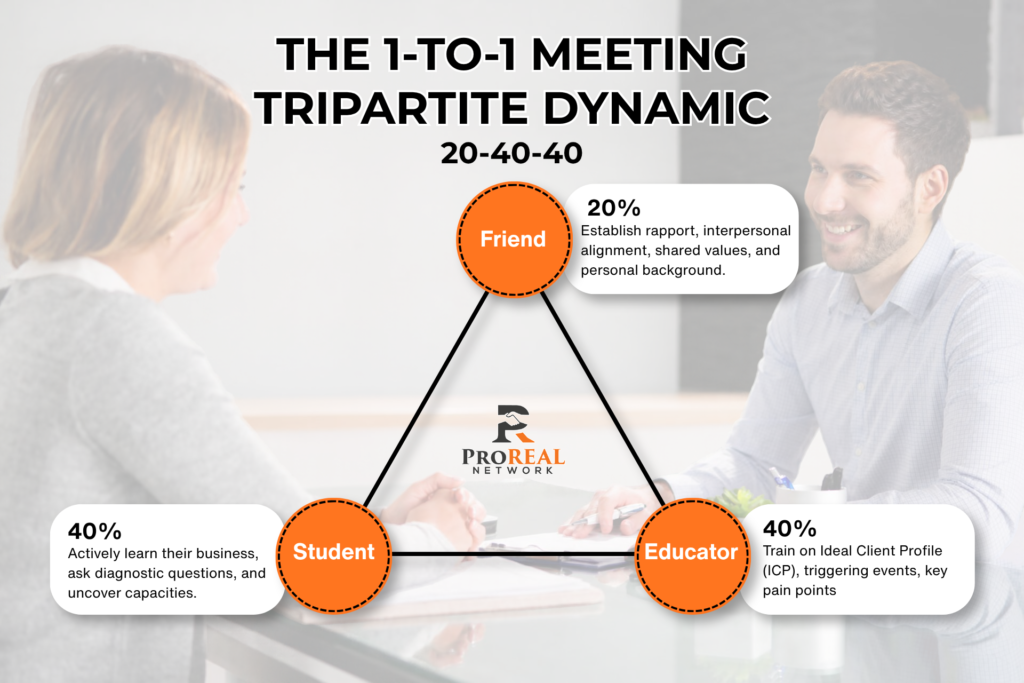
1. The “Friend” Mode (20% of Time)
- Purpose: Establish interpersonal alignment, personal background, work ethic, and shared values.
- How to execute: Keep personal check-ins focused and genuine. Discuss family, hobbies, personal origin stories, or community involvement.
- The Boundary: Do not let personal anecdotes consume the meeting. If you spend 45 minutes discussing local sports or weekend plans, you have conducted a social visit, not a strategic networking 1-to-1, which has very little benefit for discovery. However, if this happens don’t stress over it. Just schedule another 1-to-1 to cover the other bases.
2. The “Educator” Mode (40% of Time)
- Purpose: Train your peer to recognize triggering events, pain points, and specific keywords in their everyday interactions that signal a need for your services.
- How to execute:
- Define your Ideal Client Profile (ICP) with specific parameters (e.g., company size, revenue, immediate pain points).
- Share 2–3 specific “trigger phrases” clients say when they need you (e.g., “My accountant only calls me once a year at tax time”).
- Explain your exact sales and onboarding process so they know what happens after they make an introduction.
- Some networking training resources might suggest providing a clear, zero-friction introduction script they can use, and that is certainly an option. Though some would argue that a script is too formal and robotic for natural conversation. You could offer sample conversational replies and let them adapt those examples into their own natural voice.
- Very rarely will someone be able to describe and explain your business as well as you can after one sitting. This is also why it helps to have multiple 1-to-1 meetings with other members of the group. You can also set the standard of assertive learning with the next mode, student.
3. The “Student” Mode (40% of Time)
- Purpose: Uncover your partner’s niche, target audience, capacities, and referral triggers so you can actively hunt for opportunities on their behalf.
- How to execute:
- Ask targeted, diagnostic questions about their business model, past wins, worst-fit clients, and current growth goals.
- Ask them about everything you educate them on (every bullet point listed above).
- You could even actively take notes. Whether you need the notes to remember their business or not, the act of taking notes will indicate to them how serious you are.
Keep in mind that the 20–40–40 breakdown is a guideline, not a rule. Nobody expects you to put a timer on the table and awkwardly cut off a good conversation just to enforce equal airtime. What matters is keeping the core intention clear: a strategic 1-to-1 is neither a casual catch-up nor a high-pressure sales pitch.
If a meeting naturally ends up leaning one-sided—whether because someone had a complex update or simply talked longer—don’t stress over it. Just schedule a follow-up 1-to-1. If you were the one who took up most of the time sharing your business, offer the simple courtesy of making the next meeting explicitly about them.
Diagnostic Question Set for the Strategic 1-to-1
To move beyond generic pleasantries, here is a focused set of questions you could bring to a 1-to-1 meeting:
Uncovering Referral Mechanics
- “What is a specific sentence or complaint a prospective client says right before they need your help?”
- “Who are your top 3 non-competing business partners who currently send you the most business?”
- “What is a ‘red flag’ client that I should NEVER send to you?”
- “When I spot a potential lead for you, what is your preferred way for me to introduce you (e.g., three-way email intro, text group chat, direct phone call)?”
Building Operational Trust
- “What happens step-by-step when a new client signs up with you?”
- “Can you share a recent success story where you saved a client money, solved a major crisis, or delivered an outstanding result?”
- “How do you keep me updated when I send a referral your way so I know my contact is being taken care of?”
Closing the 1-to-1 Meeting Productively
Hitting it off so well that you run out of time without covering every business detail is actually a great indicator of rapport. Networking isn’t a transactional race, and many referral partnerships can take time and multiple conversations to mature before either person is ready to pass business.
That said, whenever a 1-to-1 does reach a natural wrapping point, try to touch on simple next steps:
- If you established strong clarity and rapport: Identify 1–2 immediate referral search commitments for each person.
- If the relationship is still developing: Simply outline what would be helpful for the next chat—whether that’s visiting their office, or grabbing a second 1-to-1 to focus on the side of the business you didn’t get to cover.
If leads aren’t ready yet, that is completely fine. Focus on maintaining momentum by confirming when you’ll touch base again, whether at the next group meeting or over another 1-to-1 meeting down the road.
Post-Meeting SOP: Converting Intention into Referrals
A great 1-to-1 meeting becomes exponentially more effective when paired with reliable follow-up:
- Send a Brief Follow-Up Note (Within 24 Hours): Send a summary email confirming key takeaways, their ideal client profile, and the action items committed during the meeting.
- Log Notes in Your CRM / Contact System: Record their referral triggers, ideal client traits, and personal details (family, hobbies, key dates) in your contact management system so you can easily reference them later.
- Keep an Eye Out for Connections: Look for opportunities to make a thoughtful introduction—whether a direct client lead or a valuable strategic contact. If you can make such an introduction within 7 days, that would be an excellent sign of a successful 1-to-1.
The Nature of the 1-to-1 Meeting Often Changes at Different Stages of the Relationship
Similar to how non-professional relationships can advance in stages—like moving from acquaintances to friends to dating—business referral partnerships also advance in stages, and the style of your 1-to-1 meetings will naturally adapt as trust and familiarity grow.
The more established your relationships become, the more casual the 1-to-1 meetings can become and the more time you spend on building the rapport aspect, since you already know each other’s businesses. Recognizing where you stand with each member keeps 1-to-1s effective and stress-free. Allowing the nature of the meeting to match the stage of the relationship prevents pushing for business too early—while enjoying the ease and productivity of long-term referral partnerships.
The Real Power of the Relationship: Long-Term Consistency Over Instant Volume
It is important to remember that leads may not come every week from a particular member that you’ve formed a professional relationship and referral partnership with. Business referral networking is rarely a predictable factory conveyor belt where leads pop out on a strict weekly schedule.
However, because of a well-maintained relationship, that partner is ready to refer you every time opportunities arise. When you invest in building true relationship equity and maintaining mutual clarity, you become the automatic, top-of-mind choice the second a relevant trigger phrase or qualified prospect surfaces in their daily life, and vice versa.